Before you panic: If your ROAS dropped and CPAs spiked overnight, your ads probably didn't stop working. Meta changed how they count results — and your dashboard is the last place that reflects reality right now.
If you logged into Ads Manager recently and felt a cold sweat because your ROAS tanked and your CPAs spiked overnight, you are not alone. We saw the exact same thing happen across several of our client accounts here at Three Chapter Media. But before you pause your campaigns or start firing your creative team, you need to understand what actually happened.
In March 2026, Meta rolled out a major update to their attribution model. They fundamentally changed the definition of a "click," and it is making everyone's performance look worse than it actually is. Let's break down exactly what changed, why your dashboard looks like a crime scene, and what you actually need to do about it.
What Happened to Meta Ads in March 2026?
For years, Meta's definition of a "click-through conversion" was incredibly generous. If someone saw your ad, clicked the "Like" button, and then bought your product three days later, Meta counted that as a click-attributed conversion. If they clicked to read the comments, or clicked your page name, and later converted — yep, that was a click conversion too.
Meta counted any click on the ad unit.
But as of March 2026, Meta officially changed the rules. Now, click-through attribution only counts actual outbound link clicks. If the user doesn't click the link that takes them to your website or app, it does not count in your standard click-through reporting.
All those other interactions — the likes, the shares, the saves, the comment reads — have been stripped out of the click-through bucket. Meta moved them into a newly renamed category called "engage-through attribution."
So when you ask why your Meta ads performance dropped, the answer is usually that it didn't. You just lost the padding that those engagement clicks were providing to your top-line numbers.
Why Are My Meta Ad Conversions Lower Now?
Your reported conversions are lower because you are looking at a stricter measurement system. Think of it like stepping on a scale that finally calibrated itself correctly. You didn't gain weight — the old scale was just lying to you.
When Meta stripped non-link clicks out of the default click-through attribution window, they also changed the timeframe for those actions. Click-through attribution typically operates on a 7-day window. But the new engage-through attribution — where all those likes and shares went — only operates on a 1-day window.
This means if someone likes your ad on Monday and buys on Thursday, under the old rules you got a conversion. Under the new rules, you get nothing. It falls outside the 1-day engage-through window, and it doesn't qualify for the link-click requirement of the 7-day window.
This is hitting remarketing campaigns especially hard. Remarketing relies heavily on users who are already familiar with your brand engaging with an ad and converting a few days later. Without that generous 7-day window for engagement clicks, those reported conversions are vanishing from Ads Manager.
How Does the Meta Click Attribution Change Impact ROAS Reporting?
The impact on ROAS reporting is direct and immediate. Because fewer conversions are being credited to your campaigns in the main dashboard view, your reported revenue drops — which drags your ROAS down with it.
But here is the critical part: your actual business revenue probably hasn't changed.
We run a lot of incrementality testing here at Three Chapter Media — you can read more about how that works in our guide to incremental attribution. We need to know what ads are actually driving net-new revenue, not just what the platform claims credit for. Recent industry meta-analyses of incrementality studies show that Meta's standard 7-day click attribution actually understates true incremental ROAS for click-optimised brands.
Meta's reporting was already conservative when it came to true business impact, and this new update makes it even more conservative. If you are only looking at the default ROAS column in Ads Manager, you are making decisions based on an incomplete picture.
What Should Advertisers Do About the Meta Attribution Change?
First, stop comparing your current CPAs to your February 2026 CPAs. You are comparing apples to oranges. You need to establish a new baseline based on the new rules.
Second, fix your reporting view. You can still see the conversions that Meta moved out of the main bucket — you just have to tell Ads Manager to show them to you. Here is how to do it:
- Go to your campaign in Ads Manager
- Click "Compare attribution settings" in the reporting table
- Select the "1-day Engagement" option
- View engage-through conversions alongside your standard click-through numbers
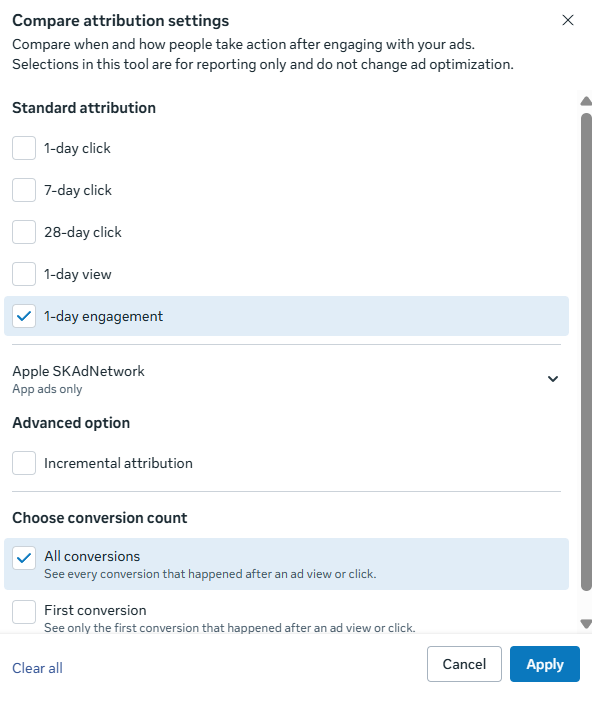
Meta's official help documentation on comparing attribution settings walks through this in more detail. By looking at both side by side, you get a much clearer picture of how your ads are actually performing.
You should also be looking closely at your Outbound Clicks metric. If your outbound clicks are holding steady but your reported conversions dropped, you know for a fact this is an attribution issue — not a creative or targeting issue.
Finally, start looking beyond the platform. If you are relying 100% on what Meta tells you in Ads Manager, you are going to make bad media buying decisions. Look at your blended CAC (Customer Acquisition Cost) and your overall MER (Marketing Efficiency Ratio). If your daily spend on Meta is the same and your backend revenue is the same, your ads are fine.
The real signal to watch: If outbound clicks are stable but reported conversions dropped, it's the attribution change — not your creative. Don't pull spend based on dashboard numbers alone until you've checked your actual backend revenue.
Navigating these platform changes is exhausting, especially when you are trying to run a business. If you are tired of trying to decode Meta's latest updates and just want campaigns that drive actual, measurable revenue, that is exactly what we do at Three Chapter Media. We build strategies based on incrementality and real business metrics, not just platform dashboards. Let's talk about getting your account back on track.